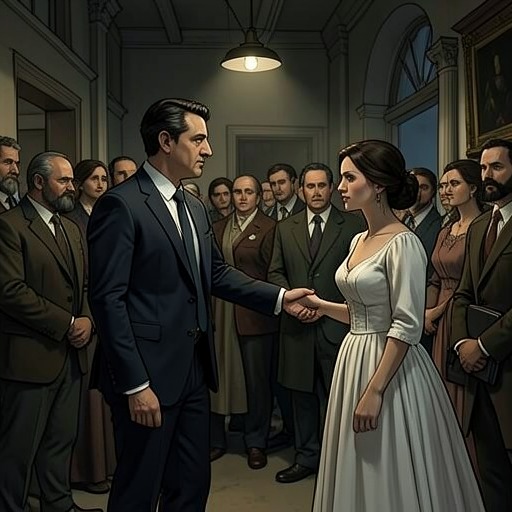
Bruno Tattaglia
The GodfatherBruno Tattaglia is a manager of a Tattaglia Family nightclub and the youngest son of Philip Tattaglia. Though he presents himself as a businessman outside the family’s prostitution operations, the club functions as a training ground for prostitutes and as a meeting place where the Tattaglias conduct underworld business. Bruno’s importance lies less in a long personal history than in the position he occupies between the family’s legitimate-looking public face and its coercive criminal machinery. His dealings with Luca Brasi reveal the Tattaglia Family’s attempt to recruit the most feared retainer of the Corleone Family, while his later death helps transform a concealed conspiracy into open war.
Identity and Position
Bruno belongs to the younger generation of the New York underworld. Unlike the older figures whom the narrative associates with the “Moustache Pete” tradition, he carries a barely concealed contempt for the old order, including Luca Brasi and Vito Corleone. His manner is outwardly respectful, but that respect is calculated rather than reverential. He treats Luca as a valuable executive who might be transferred from a rival organization, not as a man bound by an older personal code.
His authority comes through the Tattaglia Family’s organization rather than through an independent public identity. The nightclub he manages is ostensibly a place of entertainment, yet it also serves as a finishing school for women entering the city’s prostitution trade. Bruno is therefore positioned at a junction of commerce, sexuality, recruitment, and organized violence. The setting makes his proposed employment of Luca appear at first to be an ordinary business offer, even though the recruitment is designed to penetrate the Corleone Family and obtain information about Virgil Sollozzo’s narcotics plans.
Recruitment of Luca Brasi
Vito Corleone had ordered Luca Brasi to make contact with the Tattaglia forces months before the attempted assassination of Vito Corleone. Luca frequented Tattaglia-controlled nightclubs and took up with one of the family’s leading call girls, pretending to complain that the Corleone Family held him back and failed to recognize his worth. After roughly a week, Bruno approached him. The courtship of Luca as a prospective recruit continued for nearly a month, with Luca playing the part of a man infatuated with a beautiful woman and Bruno acting as a businessman seeking an able enforcer from a rival organization.
Bruno’s strategy depended on reassurance. When Luca insisted that he would never act against the Godfather, Bruno answered that Philip Tattaglia would not expect him to do so and that relations among the families were peaceful. He presented the offer as a new job rather than as a demand for betrayal. This language was intended to lower Luca’s suspicions, but it also reveals Bruno’s generational attitude: he imagines loyalty as an obstacle that can be negotiated around, while Luca treats it as the defining limit of employment and ambition.
The larger purpose of the operation was to make the Tattaglias believe that Luca wanted an independent share of the lucrative narcotics business. Luca was meant to discover whether Sollozzo planned to challenge Vito Corleone. For two months, however, nothing decisive occurred, and Luca reported that Sollozzo appeared to be accepting his defeat. Vito told him to continue only as a sideline and not to press the matter. Bruno’s role remained dormant until the night before Vito Corleone was shot.
The Murder at the Nightclub
Bruno came to Luca’s table almost immediately after Luca entered the nightclub and told him that a friend wanted to speak with him. The friend was Virgil Sollozzo. During the conversation, Sollozzo offered Luca work and invited him to consider the proposal for several days. Luca deliberately ignored Sollozzo’s extended hand and instead began to light a cigarette. Bruno then produced a lighter, held it to the cigarette, dropped it on the bar, and seized Luca’s right hand.
Luca reacted at once, twisting away, but Sollozzo had already taken hold of his other wrist. Luca was strong enough to break free from both men until a third man emerged from the shadows and placed a thin cord around his neck. Bruno and Sollozzo restrained Luca’s hands while the strangler tightened the cord. Once Luca’s strength failed, they released him, and the strangler continued until the cord cut into his neck and Luca died. Sollozzo immediately ordered that the body not be found, because its disappearance was important to the conspirators at that moment.
The scene makes Bruno both participant and witness. He does not personally wield the cord, but he initiates the physical capture that makes the murder possible. The apparent business negotiation turns into a coordinated execution, exposing the violence beneath the Tattaglia Family’s language of recruitment and commercial opportunity. Luca’s death also destroys the Corleone Family’s most loyal intelligence agent and removes the man best positioned to detect the Sollozzo alliance.
Death and War Consequences
Bruno’s own death is later reported as the Corleone Family’s first score after the hospital crisis: he was killed at four in the morning. The reprisal followed the murder of Vito Corleone and the violence surrounding the hospital defense. By then, Santino Corleone had ordered the family’s button men into action throughout New York and New Jersey, although Tom Hagen was still trying to restrain him and preserve the possibility of a settlement.
When a negotiator proposed that Michael Corleone meet Sollozzo, the Tattaglia Family’s position formed part of the offer. The Tattaglias had agreed to cooperate with Sollozzo and to accept Bruno’s death as payment for what had been done to Vito. Santino treated the arrangement as a brazen attempt to balance one killing against another. Bruno’s death thus became an item in negotiations as well as a blood feud: a life was converted into a bargaining unit, and the claim that one act could cancel another demonstrated how quickly family honor had become an instrument of political calculation.
The wider war of 1947 proved expensive for both the Corleone Family and the Five Families allied against it. Police pressure intensified after the murder of Captain Mark McCluskey, damaging gambling operations and forcing the Corleone organization to close or surrender parts of its numbers business. Bruno’s death therefore belongs to a chain of reprisals whose costs extended beyond the immediate participants. It helped establish the logic of escalation in which each family defended its reputation by creating new injuries that demanded further compensation.
Narrative Function and Significance
Bruno is a compact but revealing figure in the novel’s account of organized power. He represents an underworld attempting to modernize itself through recruitment, business language, and expansion into narcotics, yet he remains dependent on the same secrecy and violence that define the older order. His nightclub is presented as a commercial enterprise, but its operations turn a social venue into an apparatus for acquiring personnel and information. His treatment of Luca shows that the newer generation has not escaped the old system; it has learned to disguise its coercion more smoothly.
His conflict with Luca also clarifies the nature of the Corleone system. Vito Corleone’s authority rests on favors, friendship, and debts that are personal even when they support a carefully layered organization. In contrast, Bruno approaches power through position and transaction. Luca’s loyalty cannot be purchased because it is attached to the Godfather as a person, while Bruno assumes that a sufficiently attractive offer can redirect a rival’s service. The failure of that assumption is concealed by murder, but the murder itself confirms the strength of the loyalty it sought to overcome.
Bruno’s death finally illustrates the paradox of the underworld peace established by Vito Corleone. Vito had built influence by mediating among rival organizations and preserving internal authority within each city and state. Later, he declares that the families must manage their own affairs and avoid outside interference, even while seeking safe conditions for Michael Corleone’s return. Yet Bruno’s killing shows how fragile that order is: beneath agreements about peace, each family retains the power and willingness to settle its interests through assassination. Bruno therefore marks the point where covert rivalry becomes visible war, and where the Tattaglia Family’s attempt to reshape the balance of power begins to exact a corresponding price.